
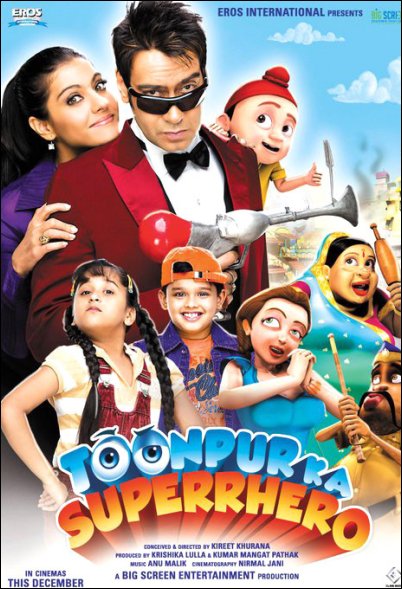
How Toonpur Ka Superrhero world was created…
-

-
 Digital Intermediate (DI) This is the final process of the film, a few shots from the film was passed on to the DI department, the team made sure that output from the CG team was in sync technically with the DI team. The challenge The trickiest part was, Read More">planning the entire movie production before weRead More
Digital Intermediate (DI)
This is the final process of the film, a few shots from the film was passed on to the DI department, the team made sure that output from the CG team was in sync technically with the DI team.
The challenge
The trickiest part was, planning the entire movie production before we would get on to the floor. Since we worked with other studios for the film, we had to keep account of all the assets that came our way, such as like live action footage scans, information about the camera lens, 2D animatics, storyboards etc. Kireet's studio 2nz Animation, provided us data regarding the color concepts, lighting keys for each shot and locations with different daylight schemes.
All the information mentioned above had to be formulated and put in place before we got into production. We also had to predict all possible loop holes that could pop up during production.
This planning enabled us to put a realistic schedule in place and hence we were able to deliver the film bang on time that we had promised our producers and Director. -
 Lighting & Compositing with Animation Our lighting and compositing team worked in tandem with the animation pipeline before the layout was set for any scene or shot. The lighting along with the compositing team, Read More">then worked collectively to create a look development image which was run through the director for his approval. So even beforeRead More
Lighting & Compositing with Animation
Our lighting and compositing team worked in tandem with the animation pipeline before the layout was set for any scene or shot. The lighting along with the compositing team, then worked collectively to create a look development image which was run through the director for his approval. So even before the animation was complete, we had our lighting and compositing process defined that saved us a lot of production time. With the animation files completed, each shot was rendered in different phases as required and defined by the lighting and compositing team.
Lighting and compositing the film
The compositing and lighting team were headed by Molly Khanna and Anondo Mandal respectively. To enhance the look of the lighting, we took single frames of all the different locations in the film with the different times of the day.
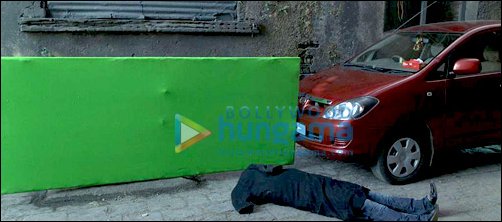
The biggest challenge was matching the lighting of the live action plates and actors with the CG environment and characters. At this phase we had more control at the compositing stage and we distinguished the different passes needed to be rendered.
This phase of the film became very technical wherein Anondo became a lighting technical director who made sure that all the technical issues were resolved, if any.
At the same time Molly, the head of compositing made sure that the color concepts that were decided upon in pre-production was achieved. Internally, I then approved the look and development images and get it tweaked if needed by the respective departments.
These single composite frames are also called LD images (Look Development) were run through the Director and Yunus Bukhari, VFX supervisor of the film for their approval. -
 Read More">Innovation We wrote a few proprietary scripts to automate a few stages of our CG production. Along with this our parallel pipeline allowed us to execute various stages of production together. This increased our production efficiency and we were able to deliver a complicated animation film on time. The Team Our animation divisions both inRead More
Innovation
We wrote a few proprietary scripts to automate a few stages of our CG production. Along with this our parallel pipeline allowed us to execute various stages of production together. This increased our production efficiency and we were able to deliver a complicated animation film on time.
The Team
Our animation divisions both in Mumbai and Chennai worked for a year on Toonpur. The senior animators like Rajesh Patil, Sadek Merchant, Amit Sharma, and Roshan were involved in the film; the animation was in very good hands. With Anondo Mandal and his lighting team along with Molly Khanna and senior compositors such as Dhananjay Singh. There was no doubt in my mind that we would deliver the parameters of quality set by Kireet Khurana. -
 Animation This is the next phase, where the animation curves on the graph editor are smoothed after adding the facial expressions for fluidity of the animated piece. The ‘graph editor’ is an animation tool, Read More">which gives the animator the flexibility to control the motion and the rhythm of movement in animation. The nodes on theRead More
Animation
This is the next phase, where the animation curves on the graph editor are smoothed after adding the facial expressions for fluidity of the animated piece. The 'graph editor' is an animation tool, which gives the animator the flexibility to control the motion and the rhythm of movement in animation. The nodes on the curves in the graph editor can be modified to suit the scene's requirements. During each process mentioned above, the respective department leads would approve the shots and then run it through me for an in-house approval before we ran it through with the director. Only on Kireet's approval would we take the process forward.
Animation Style and Live Action character integration
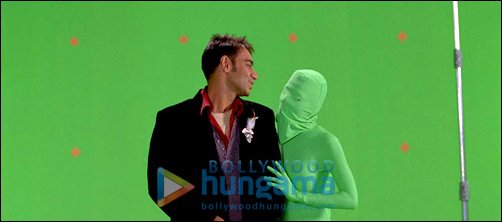
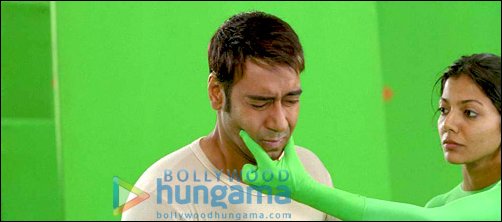
A snappy cartoony animation style with squash and stretch principles were adopted for this film. The animation was executed with the style defined by Kireet. There were shots taken that complimented the film, such as the complicated action packed climax stadium scene, which had Jagaroo character interacting with Ajay Devgn.
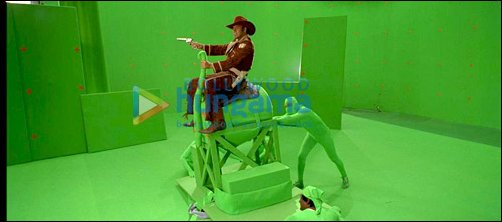
Since the film involved the live-action characters interacting with the cartoon characters and vice versa, this definitely proved to be a complicated film. The animated characters had to replace the overlapping contact areas on the live-action characters. To match the live-action plates with the 3D scenes, objects were tracked. Animators had to ensure that CG elements weren't sliding all over the place, this as taken care of in the blocking stage.