
Last year, the Malayalam cinema went on a high. Considered a smaller industry compared to Telugu, Tamil and Karnataka, it surprised the trade and industry with back-to-back huge grossers. What 2024 is to Malayalam cinema, 2025 is to the Gujarati film industry. It has been gradually rising since 2012 and did face some roadblocks, particularly during the COVID years. While the total collection of all Gujarati films in 2023 was Rs. 50 crores gross, this figure jumped to Rs. 84 crores in 2024, as per Ormax.
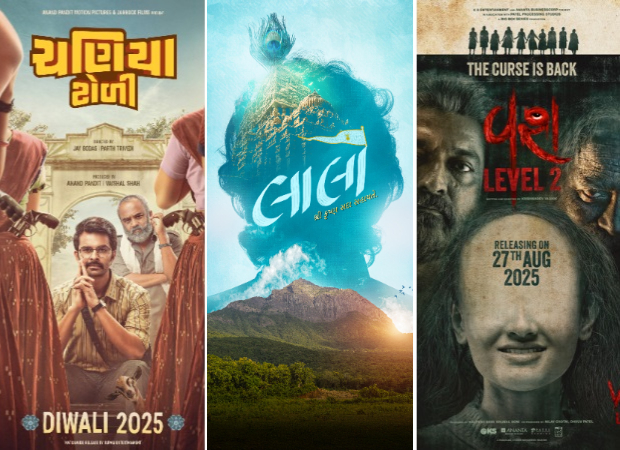
This year, the industry achieved a landmark as the earnings crossed the Rs. 100 crores mark for the first time ever. As of October 5, the figure stood at Rs. 105 crores. This was already a feat, but the industry didn’t stop here. Believe it or not, the figure has now crossed the Rs. 200 crores, thanks to the blockbuster Chaniya Toli and the all-time blockbuster and miraculous hit, Laalo - Krishna Sada Sahaayate. The former collected around Rs. 20 crores nett while the latter has crossed the Rs. 90 crores mark and will soon enter the Rs. 100 crores club! At this rate, by the time 2025 ends, the Gujarati films this year would have grossed more than Rs. 230 crores.
Gujarati cinema over the years
Gujarati cinema flourished between 1960 to 1980 as comedies, social dramas and historicals were attempted. This is the time when Upendra Trivedi, Snehlata and Arvind Trivedi became popular.
But in the 1990s and 2000s, the industry saw a decline due to competition from Bollywood, lack of infrastructure, and changing audience preferences. The films catered mainly to the rural audience and were often formulaic and low-budget. Hence, a section of the audience shifted towards Bollywood.
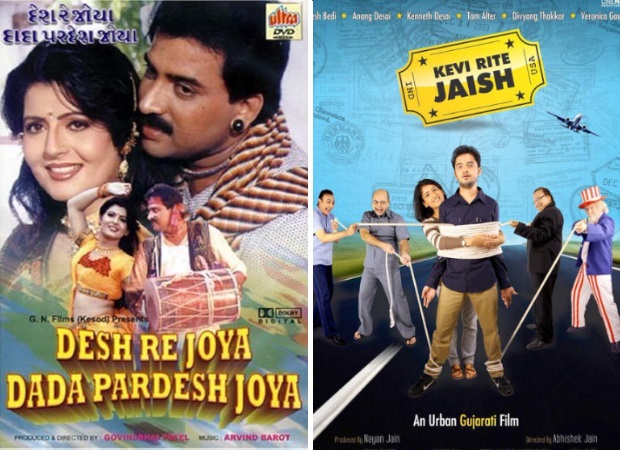
Even in this dry period, the Gujarati cinema sprang a surprise in the form of Desh Re Joya Dada Pardesh Joya (1998), produced and directed by Govindbhai Patel. It went on to do blockbuster business and is still one of the top 10 Gujarati grossers of all time. Interestingly, Rupam Entertainment is all set to re-release the classic in January 2026.
Post-Kevi Rite Jaish era
2012 was a landmark year for the industry when Kevi Rite Jaish, directed by Abhishek Jain, was released. This was a first-of-a-kind ‘Urban Gujarati film’. The posters and trailers promised a fresh entertainer. It was based on the desperation of the youth to migrate to the USA and moreover, it was based in Ahmedabad. All these relatable factors appealed to the audience and slowly and steadily, it found an audience.
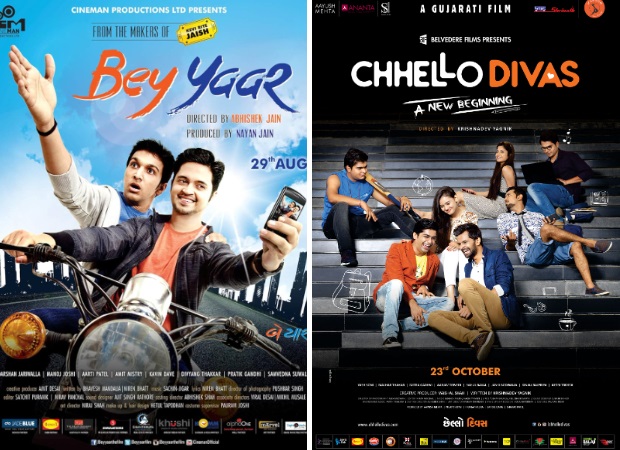
Needless to say, its success was an eye-opener to the industry, which probably assumed by then that the audience preferred watching such urban stories in Hindi. This film began the revival of the industry. 2 years later, Abhishek Jain directed Bey Yaar (2014), which had Pratik Gandhi as one of the lead actors. The film had a long run in cinemas; this writer saw the film in its 20th week in a sold-out show at Sun City, Mumbai, which speaks volumes of its success. 2015 saw the release of Chhello Divas, which emerged as a cult film.
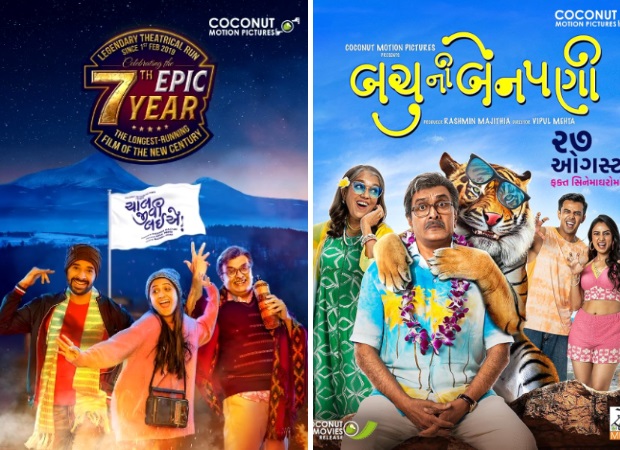
In the following years, many more Gujarati films made a mark. Chaal Jeevi Laiye, produced by Coconut Motion Pictures, was released on February 1, 2019. It was the highest Gujarati grosser of all time, collecting nearly Rs. 52 crores until the record was recently broken by Laalo - Krishna Sada Sahaayate. However, it enjoys one more record, which might not be broken by any Gujarati or any other language film, not just in India, but the whole world. The feel-good family drama continues to run in cinemas even though it's about to complete 7 years! In short, Chaal Jeevi Laiye is the Dilwale Dulhania Le Jayenge of Gujarati cinema.
The focus in Gujarati cinema is still on themes that appeal to the whole family. But a section of the Gujarati filmmakers is venturing into newer avenues and even getting success at times. Last year’s biggest hit, Jhamkudi, was a horror comedy. Kasoombo, also a 2024 release, was a grand historical action drama. Trisha On The Rocks (2024) dealt with premarital pregnancy. The 2023 flick Vash became a cult and it was remade into Hindi as Shaitaan (2024). Its sequel, Vash Level 2, was released earlier in 2025. It underperformed, but yet, managed to get nationwide attention and also a historic deal from Netflix.
The year has been great for Gujarati cinema since the start. Umbarro, a remake of the 2021 Marathi hit Jhimma, ran successfully in cinemas for many weeks. This was followed by All The Best Pandya, starring Darshan Jariwala. This courtroom drama also had a strong trend. Bollywood Hungama had reported how shows of Salman Khan-starrer Sikandar were replaced with the legal drama after the former bombed. Bachu Ni Benpani clashed with Vash Level 2 and yet emerged as a big hit. It starred Siddharth Randeria, the superstar of Gujarati cinema (who also acted in Chaal Jeevi Laiye) and Ratna Pathak Shah.
These films had already served the purpose for Gujarati cinema this year. And then Chaniya Toli and Laalo - Krishna Sada Sahaayate were sone pe suhaga.
Experts speak up
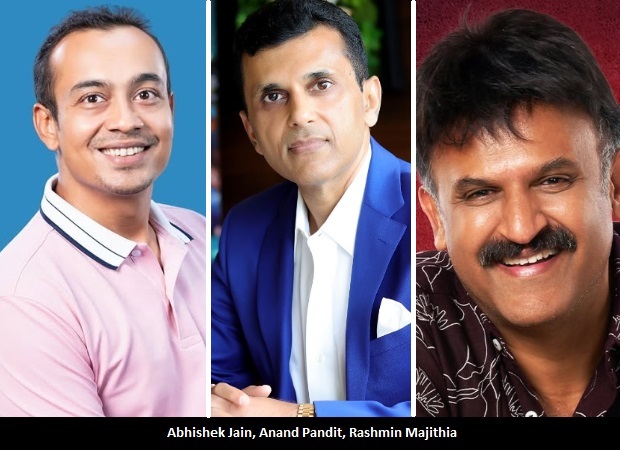
Bollywood Hungama spoke to the expert filmmakers of Gujarati cinema to understand the change better – Abhishek Jain, the director of Kevi Rite Jaish, popular Gujarati as well as Bollywood producer Anand Pandit, whose Chaniya Toli and most of the other Gujarati films have been huge hits, and lastly, Coconut Motion Pictures' Rashmin Majithia, who has produced and distributed some of the most memorable Gujarati films in the last decade, including Chaal Jeevi Laiye.
Abhishek Jain opened up about the challenges he faced during the release of Kevi Rite Jaish, “Technically, there was no ecosystem in mounting a Gujarati film, shooting it and releasing and marketing it effectively. Over the years, Gujarati films started releasing in urban centres or getting released in multiplexes, thanks to Kevi Rite Jaish. But what catapulted the industry was Bey Yaar. It ran for almost 56 weeks. It brought a lot of attention and sincerity towards the industry.”
Abhishek continued, “Back in those days, if we wanted to have a show in a cinema hall, we had to literally go pillar to post and request the exhibitor for a showcasing. But now, they do give us decent showcasing in terms of the number of screens or the timings of the shows.”
He also said, “In 2015, the Gujarat government even declared a subsidy policy, or the Film Appreciation Policy. Brick by brick and milestone after milestone, things have improved and an ecosystem has been created.”
Anand Pandit explained, “The Gujarati film industry has changed a lot and even the Gujarati viewer has evolved. People are now ready to go and watch Gujarati films. Earlier, a Gujarati film used to earn a maximum of Rs. 50-75 lakhs. Gradually, it jumped to Rs. 3 crores, followed by Rs. 5 crores. Now, we have reached a stage where a film earning Rs. 10 crores is considered unsuccessful. In short, it is on par with Hindi films. Today, some Bollywood films with big stars also earn less than Rs. 10 crores, despite releasing all-India. As for Gujarati films, there have been several films which have earned more than Rs. 7-8 crores off late.”
He also stated, “Gujarati filmmakers and creative people have now realized that if they deliver a quality product, the people are ready to spend Rs. 300 on a movie ticket.”
Anand Pandit explained his point by revealing, “We released our film Chaniya Toli along with Thamma and Ek Deewane Ki Deewaniyat on Diwali this year. Yet, in Gujarat, Chaniya Toli did more business than the combined business of those two Hindi films! This shows that people are ready to come to the cinema halls. Also, they are ready to spend a bomb as well. Earlier, people had reservations of spending more than Rs. 60 for a ticket of a Gujarati film. But they had no qualms shelling out Rs. 300 to watch a Hindi film. But I was shocked to see that for Chaniya Toli, the recliner seats, priced at Rs. 800, used to get booked first! This has boosted the confidence of the whole industry.”
While Abhishek Jain credited Bey Yaar for the boost, Anand Pandit noted, “The defining moment, in my opinion, was Chhello Divas. 10 years ago, it managed to do business of Rs. 17-18 crores. Bey Yaar and Kevi Rite Jaish also left a mark and are a part of Gujarati 2.0 cinema.”
Abhishek Jain further said, “Credit goes to four elements. One is the government which took the matter seriously and came up with a subsidy policy. Secondly, the media has been generously talking about Gujarati cinema. Thirdly, the producers are now taking a bigger leap and making films that are relevant and rooted. Lastly, the biggest pillar is the audience who have shed the inhibition of watching a Gujarati film. Probably, they felt they were getting cheated because of the value of money they were putting in.”
The quality cinema that was churned out also helped, said Abhishek “Wrong Side Raju (2016; starring Pratik Gandhi and backed by Fuh Se Phantom) was the first Gujarati film in years to win a National Award. Hellaro (2019) also got honoured at the National Awards. Chhello Show (2021), meanwhile, was India’s official entry to the Oscars. This has also helped in the Gujarati industry being revered. It’s been a 15-year-long journey.”
Rashmin Majithia made an interesting observation about the jump in earnings this year, “The growth has been on expected lines. Laalo went on to do extraordinary business, because of which such a huge number has been achieved. If you remove this one film, the growth has been 20-25% as compared to last year. Nevertheless, it is excellent and heartening that the audience developed a craze for a Gujarati movie.”
All three agreed that any well-made Gujarati film costs Rs. 3 to 5 crores to be made. Rashmin Majithia said, “You can’t make a good film for less than Rs. 3 crores. Of course, there are some expectations. But if we really want to make a well-made film, Rs. 3 to 5 crores are sufficient and this includes P&A.”
He added, “Day by day, Gujarati people across the world are showing interest in Gujarati movies. We can’t compete with the international movies or even the standards of certain industries. Films down South, for example, have huge budgets. They also have stardom, which we lack as well. We don’t even have competitive and creative ideas. We often get influenced. Some of our films, however, are creative. Chaal Jeevi Laiye had a novel story. It’s not copied from anywhere and that is also what people appreciated.”
Anand Pandit also confirmed that originality works, when asked about his success ratio, “There’s no secret. We work on the original story and spend more money on writing. All our films are originals. You can be inspired but it’s not right to copy anything. Also, we incorporate elements that Gujarati audiences love – humour, emotions, family-oriented themes, etc. Our films are not obscene. That restricts the audience. You’ll be able to watch our Gujarati film with your family. That’s why it’s rare to see a person coming all alone to watch films made by us. Usually, a person buys at least 4 tickets (smiles).”
Rashmin Majithia stressed for more successful grossers on a regular basis, “Chaal Jeevi Laaiye, which released in 2019 and Laalo, which released in 2025, crossing Rs. 50 crores each doesn’t indicate that the industry is stable. In my opinion, things will be better when 10 Gujarati films in a year are able to collect Rs. 10 crores each. This should be our target. Only then can we say that our industry is stable and that a steady crowd is coming to the cinema halls to watch Gujarati movies. If we don’t consider Chaal Jeevi Laiye and Laalo, I don’t think more than 20 lakh people are watching Gujarati films. The highest grosser after Chaal Jeevi Laiye collected Rs. 25 crores.”
He also said, “Gujarati film producers are apprehensive of films made in other languages. That is the competition we face. Also, Gujarati films don’t perform in the first or second week. In such a scenario, several films are often removed due to the pressure on the theatres. However, change is happening gradually in this regard and Gujarati people are now rushing to cinemas to watch certain Gujarati films as soon as they are released.”
The secret behind Laalo
A conversation about the Rs. 100 crores grosser Laalo - Krishna Sada Sahaayate can’t be ruled out. Abhishek Jain explained what went in favour of the film, “It’s a simple and honest film and also relatable. Once a film is released, nothing is in the hands of the producers. So, a strong word of mouth, the relatability factor and the audience’s generosity in patronizing the film in their language have catapulted the film to a high level.”
Rashmin said, “Laalo - Krishna Sada Sahaayate is a craze, just like how Jai Santoshi Maa (1975) had become a rage at one point in time. It’s absolutely great that people are going for it in such numbers out of shraddha. But this is an exception; it can’t be repeated again.”
The OTT hurdle
One challenge that remains in front of Gujarati cinema is the lack of support from the major streaming giants. Gujarati films are usually released digitally on ShemarooMe or Jojo. Netflix and Amazon Prime Video rarely pick up a Gujarati film. Filmmakers have complained in the past that even if their films are bought by these OTT platforms, they are not compensated handsomely for it.
Rashmin Majithia confirmed, “OTT platforms have a plethora of content to choose from. The budget allotted to Netflix and Prime Video for Indian titles has been exhausted. Hence, they do not pay us well. That’s why we have to rely only on cinema halls and create craze and respect among people for Gujarati films.”
Anand Pandit exulted, “It’s a loss for Netflix and Amazon Prime if they are not acquiring Gujarati films. There’s a huge audience for our films in India and overseas and these platforms are losing out by not buying our films.”
Abhishek Jain signed off on an optimistic note, “Things are growing. I am sure the OTT platforms are open to having Gujarati films. Recently, Netflix paid a hefty amount to acquire Vash Level 2. It’s not necessary that we should have platforms catering only to Gujarati films. If the international streaming giants can also warm up to Gujarati films, it’ll prove to be of big help.”