

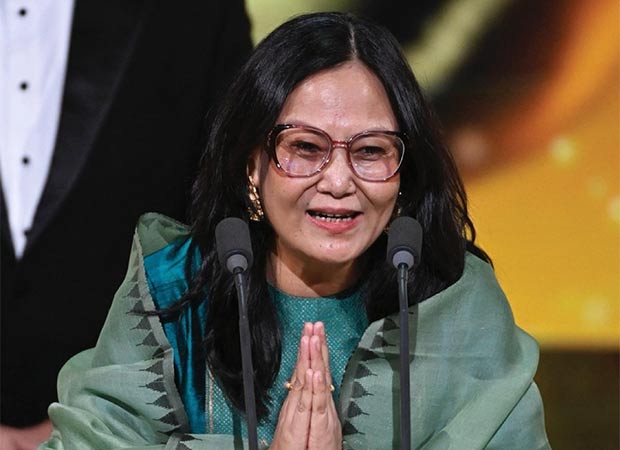
Were you surprised when BAFTA removed your innocuous speech from its website?
No. Mine was not the only speech they removed and later re-uploaded. There was a separate incident during the event because of which I assume they had to review certain speeches. I’m referring to the involuntary racial slurs that were shouted during the event by Tourette’s campaigner John Davidson.

Manipur is often seen from the outside as a troubled paradise. Do you hope to change that perception through your cinema?
I don’t take myself or my work so seriously that I think it can change perceptions. All I hope is that through Boong, people become more aware of Manipur and feel curious enough to discover the place through whichever medium they prefer.
Do you think cinema must, at some level, always be politically informed?
Personally, as an audience member, I enjoy films and books that offer a social, political and cultural context. I like learning from those additional layers. But as a filmmaker I don’t think it is compulsory. If the story doesn’t demand it, then there’s no need to force those elements into it.
Tell me about the genesis of Boong.
You know, I made Boong as if it were my first and last film. I never had this great ambition to become a director. I was quite happy being a first assistant director. Alongside that, I hoped I could pursue my real dream, which was writing. Boong is really a sum total of my life experiences. It’s almost like a diary — everything I went through, things I feel strongly about, all of it poured out. I was just trying to get it out of my system. It’s literally luck that it eventually became a film. I never imagined it would translate into one.
Now that you’ve tasted success, are you eager to continue directing?
Only if I have a story I truly want to tell. If that doesn’t happen, I’m very happy to continue being a first assistant director. Directing is something very personal to me. After everything I went through making this film, I feel that if I start directing simply because I’ve won an award — like a BAFTA — and it becomes just another job, then it would kill the joy for me. So yes, only when I really have something to say. Until then, I’m quite happy shouting “Action” and “Cut” on sets the way I did as a first AD.
Were you always a big movie buff?
Not really. In fact, I had not even watched Sholay until much later. I watched it only because it was known to be a question people were asked during admission interviews at Jamia Millia Islamia. When I finally saw it, I loved it. That was perhaps the first time I started discovering Indian cinema deeply. I admire many filmmakers, but one who really stands out for me is Billy Wilder. I love the simplicity of his storytelling. His film Sunset Boulevard is a favourite. Ironically, I had almost zero interest in filmmaking when I was younger.
Tell me about your life before Boong.
My life has been a series of very happy accidents. I never intended to study film or work in this field. I was actually preparing for MBA entrance exams when I happened to participate in an India quiz show hosted by Siddharth Basu. After returning to the hostel that night, I couldn’t sleep. I realised I wanted to be part of that world. There was something warm about the atmosphere of a shoot. It felt like a family — people weren’t dressed in formal suits; the environment was casual and creative. I think I was also subconsciously trying to escape the rigid structure of a corporate life. I’ve always had a rich inner world, and perhaps cinema was the place where that imagination could exist. Interestingly, the maternal side of my family in Manipur was deeply involved in cinema.
Really?
Yes. The first three cinema halls in Manipur were owned by people from my maternal family. But my paternal side was strongly academic, so I never thought of cinema as an option. The path seemed very clear — study, build a career in academics or business. Perhaps those cinematic genes from my maternal side eventually broke free.
So what did you do next?
The first thing I did was sell my MBA preparation books. Then I treated my friends to bhelpuri outside my Miranda House hostel and announced that I was going to pursue filmmaking — even though I barely knew what it meant at the time. Soon after, I applied for the Mass Communication course at Jamia Millia Islamia and got through. That was where everything finally began to make sense.
Was it difficult putting together such a delicate film, considering Manipur hardly has a film industry?
Yes and no. Initially it was difficult to find people who could work on the film. Some who were willing to join were uncomfortable with the standard working hours we are used to in Mumbai — eight or twelve-hour shifts. But in hindsight, I actually admire that. People in Manipur have different priorities. Work is not always the most important thing in their lives. That perspective also made us more relaxed about filmmaking. Eventually we built a crew from people with different skill sets, and somehow everyone fit together perfectly. It all happened very organically.
How did you find those remarkable child actors?
Manipur doesn’t have a structured casting system, so everything happened through word of mouth. We shared the description of the character we were looking for and spoke to people in schools, markets, and neighbourhoods. That’s how we found Gugun Kipgen. Interestingly, he had come for a job interview with us. I liked him immediately because he refused to audition. He said, “I don’t want to audition because I don’t know the language.” He was so cheeky and confident that I knew instantly he was perfect for the role. And he truly was.
Also Read: Boong director Lakshmipriya Devi credits Excel Entertainment ahead of March 6 release
BOLLYWOOD NEWS - LIVE UPDATES
Catch us for latest Bollywood News, New Bollywood Movies update, Box office collection, New Movies Release , Bollywood News Hindi, Entertainment News, Bollywood Live News Today & Upcoming Movies 2026 and stay updated with latest hindi movies only on Bollywood Hungama.