

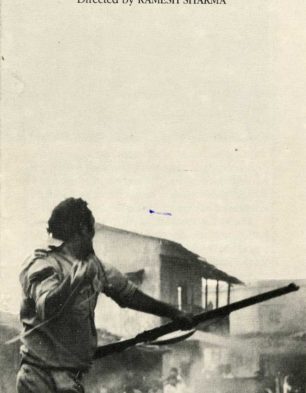

*New Delhi Times, 1986 A Political Thriller- Review with Facts*
New Delhi Times Today Rewatched on YouTube after around 40 years. In 1986 watched at Nandan.
If _Mere Apne_ + _Apanjan_ were about personal loneliness, this one is about institutional loneliness. The lonely journalist vs the system.
*The Facts:*
1. *Director + Cast*: Directed by Ramesh Sharma. Script by Gulzar. Shashi Kapoor as Vikas Pande, crusading editor. Sharmila Tagore, Om puri, Kulbhusan Kharbanda, Manohar Singh Plus a young Markand Das as the photojournalist.
2. *Plot core*: Vikas Pande takes over _New Delhi Times_ newspaper and starts exposing the nexus between politicians, police, and underworld. His own paper’s management + govt want him to shut up. Sound familiar? CJP energy, 1986 edition.
3. Accolades: The film won three National Film Awards in 1986, including Best Actor for Shashi Kapoor, Best Debut Film for Director Ramesh Sharma, and Best Cinematography for Subrata Mitra. Shashi Kapoor was 48 here and played it with zero glamour — rumpled shirts, tired eyes, chain-smoking.
4. *Relevance*: Made post-1984. The film is about Emergency hangover, press freedom, and how “national interest” is used to kill truth. The famous line: “Khabar chhapni hai ya nahi?” still hits.
5. *Style*: Ramesh Sharma shot it like a docu-thriller. No songs to break tension. Real locations in Delhi. Feels like you’re in the newsroom at 2 AM.
*The Scene That Ages Best*
Vikas Pande vs the owner. Shashi Kapoor doesn’t shout. He just places the resignation letter + the truth on the table and says “Print this, or don’t”. No background score. Pure spine.
Rewatching it in 2026 hits different. Back in ‘86 it was about Emergency + political nexus. Today it’s a manual for every journalist fighting clickbait vs credibility. Ramesh Sharma basically shot _Spotlight_ before _Spotlight_ existed.
*Gulzar + Tapan Sinha Connection*
Tapan Sinha showed the abandoned woman, Gulzar wrote Poetry on the wound.
If those two showed how cinema treats the abandoned old, _New Delhi Times_ Ramesh Sharma shows how cinema treats the inconvenient truth-teller. Shashi Kapoor’s Vikas is the older version of _Mere Apne_’s Sanju — idealism meets reality, and reality fights back.
Markand Das’s photographer stuck with me. Young guy with a camera, no godfather, just proof. He’s the Chhaya Devi of journalism — invisible till he shows you the wound.
*The Real Hero: Subrata Mitra, Cinematography*
Solo watching let me see it — Subrata Mitra. The man behind _Pather Panchali_, _Charulata_, _Aranyer Din Ratri_ for Iconic Ray. Ramesh Sharma got a legend.
*What makes his work in this film mesmerizing:*
1. *Newsroom as a maze*: Long corridors, buzzing fluorescent lights. He lights Delhi grey + smoky. The office is a cage even before the system traps Vikas.
2. *Camera movement*: Handheld when Vikas chases the story vs static tripod when owners/politicians talk. Movement = truth-seeking. Stillness = power.
3. *Night scenes*: The press printing sequence at 3 AM. Deep shadow + single source light on Shashi Kapoor’s face. Mitra’s bounce lighting puts moral ambiguity right on his skin.
4. *Simplicity*: No flashy angles. He lets composition accuse. Vikas at the typewriter, back to camera, city lights blurred — _Charulata_ loneliness in a newsroom. “Let the room be dark if the room is dark”. No Bollywood sheen on corruption.
He’s invisible till he shows you the wound. Just like Chhaya Devi in _Apanjan_, just like Markand Das’s boy with the camera.
*My view*
Not as poetic as Gulzar in Mere Apne, not as raw as Tapan Sinha in Aponjon. But Ramesh Sharma + Subrata Mitra + Shashi Kapoor made a film that ages well. In 2026, with “paid news” and “godi media” debates, _New Delhi Times_ feels less like fiction, more like prophecy.
Watch it if you want to see what Hindi cinema looked like when it was angry and didn’t care about box office. Shashi Kapoor proves you don’t need 6-pack abs to be a hero — you need spine.