

 Add to Favorites
Ratings
User ratings
Rating analysis
- Excellent0.0%
- Very Good100.0%
- Good0.0%
- Average0.0%
- Poor0.0%
Critics Review
Reviews

rabbipantho
Mehboob Khan's 1949 classic, 'Andaz', was a landmark film in the careers of its three leading…
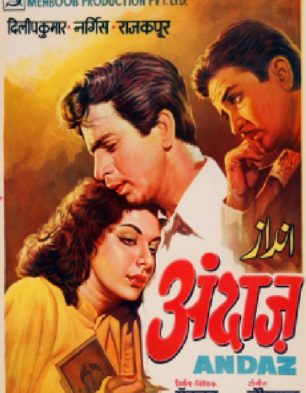
Mehboob Khan's 1949 classic, 'Andaz', was a landmark film in the careers of its three leading actors, Raj Kapoor, Nargis and Dilip Kumar. All three actors had begun their careers in the early forties and were yet to attain the superstar tag when 'Andaz' happened. Hence, what is considered a casting coup today, was not exactly so back then, and it would have been quite natural for all three to come together in a movie. In fact, it is only after the success of 'Andaz' that the careers of all three really took off. Raj Kapoor had just about begun his career as an actor, with 'Neel Kamal' in 1947 opposite Madhubala. In the following year he established RK Studios and made his debut as producer director cum actor with 'Aag', the first film to star him and Nargis, but it proved to be a flop. Nargis, who is better known today for her role in 'Mother India', also directed by Mehboob Khan, acted in her first film as an adult in the director's 'Taqdeer' in 1943, while Dilip Kumar, the only member of the cast who is still alive, had just about tasted success with 'Jugnu' in 1947. Following the success of 'Andaz', the Raj Nargis duo went on to deliver a series of hits for the RK banner, beginning with 'Barsaat'. Dilip saab too steadily climbed the ladder of success as the tragedy king but not before acting in 'Aan' and 'Amar', also directed by Mehboob Khan. Nargis too shared a good association with him and went onto star in his iconic 'Mother India'. Despite being made in the late forties, 'Andaz' is ironically very modern in its tone and subject matter. The director questions the possibility of friendship between members of the opposite sex, a debate which rages in many drawing rooms even today, some 60 years down the line. Even though the film promotes traditionalism, it still has a very contemporary appeal. The original triangle love story, it spawned a number of such triangular fare in movies down the ages, but rarely in such an effective or memorable manner. The film's story is about a rich man's daughter Nina (Nargis), who encounters a young man, Dilip (Dilip Kumar), one day while out riding. She loses control of her horse and he rescues her. Dilip is instantly attracted to Nina and now starts frequenting her house. He manages to strike up a friendship with Nina and her best friend Sheela (Cukoo) and entertains them with playful banter and song. Nina's father (Murad) does not approve of the growing friendship between the two and frequently tries to warn Nina of the repercussions, but to no avail. Anyway, the inevitable happens and Dilip falls in love with Nina but is unable to tell her about his feelings as Nina's father passes away due to a sudden heart attack. Nina is heartbroken and Dilip naturally offers her solace and comfort in these trying circumstances. But Dilip is in for a rude shock when Rajan, Nina's fiancée arrives from London. He feels betrayed as Nina had never ever mentioned a fiancée. Rajan and Nina's wedding is fixed and on their wedding night, Dilip lays bare his heart before Nina. On one level, she is shocked by his confession, but at a deeper level, it is exactly as she had suspected long ago. Whether she likes it or not, the relationship with Dilip becomes a cause of strain in her marriage, with Rajan suspicious of her relationship with Dilip. He now attempts to keep her away from their little daughter. On the other hand, Dilip's frustrated desire for Nina takes a toll on him and leads to both men having a showdown. The buildup finally takes a melodramatic turn as Nina guns down Dilip to prove her innocence. She is now tried in court for Dilip's murder. A little late in the day, Rajan discovers to his dismay that Nina was never unfaithful. His realization comes too late to save Nina as he had already testified against her in court. Coming as it did so close on the heels of India's independence, the film puts forward a confrontation between tradition and modernity, which is equated with India and the West. Of course, Mehboob Khan sides with the voice of tradition and hence you have Nina telling her husband that he should bring up their daughter with a lot more care so that she should not make the same mistakes as her mother. Nina clearly holds her Western or so called modern ways to blame for the disastrous turn her life has taken. Despite the hype surrounding the presence of the Dilip saab and Raj Kapoor, the film actually belongs to Nargis, who delivers an absolutely flawless performance. The success of 'Andaz' established Nargis as the reigning queen of the box office at the age of 19! Her poise, her assurance, her dignity and her charm brought out the many shades of Nina's character. The actress manages to make an easy transition from the carefree, flamboyant Nina of the first half to the intensely controlled Nina of the second one. Her body language and her terrific voice modulation would prove to be an invaluable lesson in acting for any of our actresses today. Adding to the drama was definitely the x factor, or the on screen chemistry that sizzled between Nargis and her two male counterparts. As for the male leads, they are a perfect foil for each other. While Raj Kapoor overplays it slightly, Dilip saab is subtle as ever, letting that one look, or one gesture speak volumes. Even though this is an early film, the tools of the trade were all in place. Perfect modulation and a restrained performance have always been the hallmarks of his acting style, coupled with an emotional intensity, all of which are very much visible in this early film as well. 'Andaz' was Raj Kapoor's first success at the box office before he went on to entrench himself in the hearts of critics and the public alike. He carries off his jealous husband act very well, one which he repeated years later in the Vyjyantimala Rajendra Kumar starrer, 'Sangam'. The main cast is well supported by cameos from Murad and Cukoo. Even though one may or may not agree with Mehboob Khan's view of modernity and tradition, this film, like his later Mother India, is one of those movies, which have helped lay down the grammar and vocabulary of Hindi films as we know them today. The film has been brilliantly written (story by Shams Lucknavi), and the dialogues (by S. Ali Reza) are clever, witty and cosmopolitan in tone. There is nothing crude about this movie, neither in its tone nor in its treatment. The director has managed to impart a certain gloss, and grace to this movie, which makes it stand out from the many others made during the same period. It is a beautifully lit up canvas and Faredoon Irani's cinematography imparts the final touches. The music department of the movie has been handled by Naushad with the lyrics being written by Majrooh Sultanpuri. This is one of those rare films where Mukesh even sings for Dilip saab, and an even rarer film where Naushad uses the services of Mukesh instead of turning to his favourite Mohammed Rafi, who comes in for just one duet in the movie. The rest of the songs are divided between Mukesh and Lata Mangeshkar and consist of such gems like, 'Uthaye Ja Unke Sitam (Lata), Toote Na Dil Toote Na, Hum Aaj Kahin Dil Kho Baithe, Jhoom Jhoom Ke Nacho Aaj, Tu Kahe Agar (Mukesh),' all of which are an intrinsic part of the golden era of Hindi film music. 'Andaz' stands out for the high productions values, its technical gloss, it's very modern tone, the strong content and the high voltage performances. Another aspect that works very well for the film is the manner in which the director cleverly manipulates the audience response, by the fairly late entry of Nina's fiancée and the subtler manner in which he builds up the friendship and romance between Nina and Dilip. This is clever writing and reveals the strong vision of the director, who knew the direction he wanted to steer his ship in. Truly, a great effort, 'Andaz' can clearly rank alongside 'Mother India' as being Mehboob Khan's best directorial effort.
Read more Less